Understanding why you do what you do – or plan to do – is one of the keys to selling yourself as a team member or an employee. It says a lot about you, why your goals are what they are, and as a result, what kind of teammate you would make. You will always need to sell yourself first regardless of what you do or plan to do.
The first main point of your sales speech is about telling your audience a little about why you are here. Is it… because you want to make yourself more valuable as an employee? to make the big bucks? because you really enjoy the process of planning, building, and maintaining a website? because you like the artistic side of creating a site?
This TED Talk help you think about your Why, why you need to understand your own Why, and why to share our Why.
You each will give a 3-5 min presentation to “sell” yourselves to your classmates for placement in to groups for next semester. You will prepare a typed, formal outline for the speech that will be turned in on your blog the day you speak. I have provided a template below that you are to use to create that outline. For your visual aid, you will create a PowerPoint or Google Slide Show with no more than eight (8) and no less than five (5) slides. One slide for the introduction, one for the close, and one or two each for each main point. Slides should follow the Six and Six Rule – no more than six line of no more than six words each. Pictures are great.
As you present your speeches, your classmates will take notes as part of their own grade.
Please use the following preparation outline:
Introduction:
I. Attention Getter: (Tell us something that will immediately grab our attention)
II. Listener Relevance: (Tell us why we should listen to this presentation)
III. Speaker Credibility: (What research/personal experience make you credible on this topic)
IV. Thesis Statement: (In one sentence, what is the goal of your speech?)
V. Preview: (Tell us specifically and concisely, in order, what your main points will be.)
Transition: (Take us to the first main point)
Body:
I. Main Point One (Tell us your “why”):
Listener Relevance Link: (Tell us how this point connects to us)
A.
1.
2.
B.
1.
2.
Transition: (Take us to the second main point)
II. Main Point Two (tell us about your technical skills):
Listener Relevance Link: (Tell us how this point connects to us)
A.
1.
2.
B.
1.
2.
Transition: (Take us to the third main point)
III. Main Point Three (tell us about your Success Skills):
Listener Relevance Link: (Tell us how this point connects to us)
A.
1.
2.
B.
1.
2.
Transition:(Take us to the conclusion)
Conclusion:
I. Restate Thesis (Restate the main idea of the presentation)
II. Main Point Summary (Explicitly review the main points you talked about)
Format: Two pages, Typed, Double spaced, Include opening paragraph, Body, Closing paragraph, turned in on your blog. A good way to do this is to do it in Word (use the spelling and grammar check) then drop it into your blog. Make sure you use paragraphs – this is not all one paragraph.
Organizations are created to accomplish goals. In the process of working toward those goals, a culture develops. A culture is the character and personality of your organization. It’s what makes your organization unique and is the sum of its values, traditions, beliefs, interactions, behaviors and attitudes.
A part of your project experience will be to identify and describe the culture of the organization with which you are working. We are going to use this class for practice in identifying the elements of an organization’s culture.
Most of us are at least subconsciously aware of the culture of any group or organization of which we are members. Several of the elements are discovered by participation within the group while others are realized through observation. Some of the major elements of culture are:
Rites, ceremonies and rituals ( Rites of passage) Fairy tales, myths, stories and legends (Stories passed down) Heroes (Idealized founders, etc.) Language (What style is used) Humor and play (Reduce tension, build rapport, share positive feelings) Rules (The code that must be followed) Metaphors (may be used to break down issues, etc.) Physical setting (Physical environment) Stories (Specific stories told or passed down) Values (Behaviors that do not change)
To understand the “cultural identification” process USE THIS CLASS as an example. From the 10 elements above, CHOOSE 5 and describe this class in those terms. You will need to include examples from class for each element.
***Remember to use examples to support your element choices. This is often the most forgotten part of this assignment.
It is important that whether for business or personal use that we follow the basics of email etiquette. By doing so our recipient will likely feel more inclined to respond, we will be more of a joy to communicate with, and we will be perceived as a caring and intelligent human being. In your emails for this class (whether they are to your instructor or your classmates), please practice the following:
Subject Line
Make sure you always include a subject line that will identify exactly what your recipient will need to know to know what you are writing about and find your email again later. Always include project names/numbers, section numbers if it is for a class. Make it as easy as possible for your recipient to know what you are talking about.
ITEC 3650 Absence Feb 1
Design details SpaceX Dragon
ACOM 1300 sec 02
Design Conversation follow up
2. Include greetings and closings
Make sure your email includes a courteous greeting and closing. These things help to make your email not seem demanding or terse.
Dear, Hi, Hello (their name)
Thank you, Thanks, Sincerely, Take care, Have a good night, Regards, Best (your name)
3. Address your contact with the appropriate level of formality and make sure you spelled his/her name correctly.
Dr., Mr., Ms., Mrs.
If you’re not sure if your instructor has a doctorate, use Professor
4. Write in short paragraphs
5. Follow grammatical rules
Emails should follow the same rules of punctuation as other writing. Capitals are often misused. In particular, you should:
Never write a whole sentence (OR WORSE, A WHOLE EMAIL) in capitals.
Never write a whole sentence in small/lowercase. it gives the perception of laziness and carelessness.
Always capitalize “I.”
Always start sentences with a capital letter.
Multiple instances of ??? or !!! are perceived as rude or condescending.
Type in complete sentences. Typing random phrases does not lend to clear communication.
6. Spell check
Emails with typos are simply not taken as seriously.
7. Proofread out loud
Read your email out loud to ensure the tone is that which you desire.
Are you clear about the goal of the email? Is your request or question easily identifiable?
Don’t hesitate to say “hope you are well” or that you “appreciate their help,” but do so at the end of the email.
A few additions of the words “please” and “thank you” go a long way.
Professional Voicemail Etiquette
1. Say “Hello” and the recipient’s name.
This helps verify that this message is intended for the recipient.
Ex: “Hello, Ms. Johnston.”
2. State your full name and what class you are taking with the professor.
Your professor is most likely teaching several sections, so it is important to identify who you are. Also, since in an online class, the professor does not hear your voice as frequently.
Ex: This is Elizabeth Reves from your online ACOM 1300 class.
3. State the purpose of the call.
This should be a short message that summarizes the reason for your call. Long, drawn out messages may be confusing or get cut off before you get to the point.
Ex. I am calling to get some clarification about the application section of our ethical case scenario assignment.
4. Set expectations
State whether you expect a call back.
Ex: If you could give me a call, that would be great!
5. If you do expect a call back, leave the number and the time of day you will be available.
Make sure that you state the number (beginning with the area code) so that they can return your call. You need to say the number slowly enough that the professor can write the number down.
Ex: My number is 501-550-5555.
6. Repeat your name and phone number.
This gives the person another opportunity to write your name down and confirm your phone number.
Ex. Again, this is Elizabeth Reves from your online ACOM 1300 course, and my number is 501-550-5555.
7. Closing the call.
Make sure to end the voicemail with a closing statement.
Ex: I look forward to hearing from you. Bye.
Full Message:
Hello, Ms. Johnston. This is Elizabeth Reves from your online ACOM 1300 class. I am calling to get some clarification about the application section of our ethical case scenario assignment. If you could give me a call back, that would be great! My number is 501-550-5555. Again, this is Elizabeth Reves from your online ACOM 1300 course, and my number is 501-550-5555. I look forward to hearing from you.
* “A chatbot is a program that engages in conversations with humans using Artificial Intelligence (AI) technologies such as Natural Language Understanding (NLU) and Machine Learning. Think of an AI chatbot as a virtual assistant that you can talk with in a two-way dialogue” (webio.com, 2023).
Assignment Description:
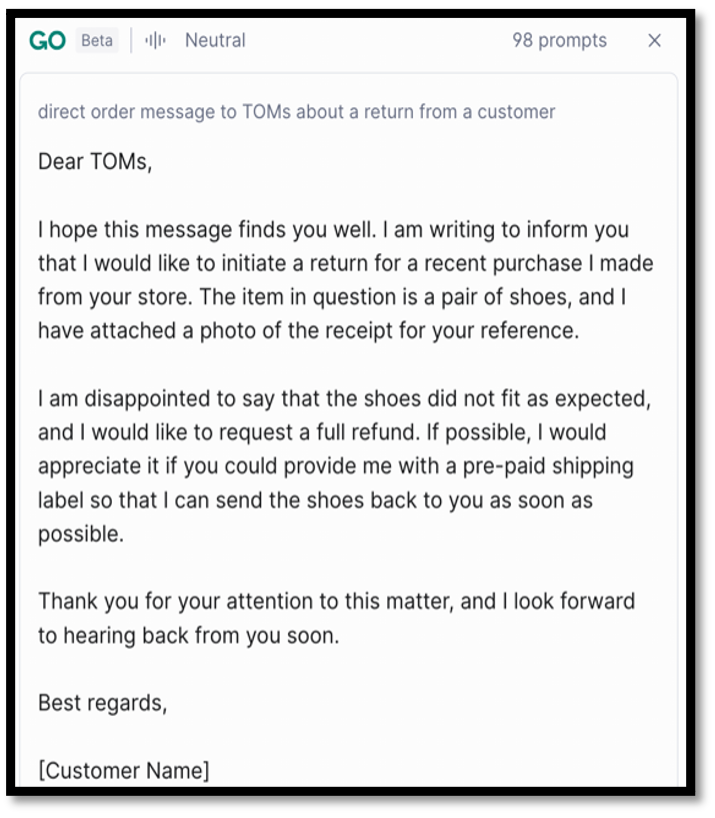
Use chatbot software (Grammarly is an option) to create a direct-order message.
Type in the prompt box key ideas: direct-order message, a company name, praise, return and/or complaint.
Bring the AI-generated response to class with your answers to the following 5 questions.
Questions to Answer
What is the benefit of using artificial intelligence (AI) technologies to write your message for you?
Does the message flow together? Explain your answer.
Is it ethical to use AI to write your messages?
Is the language personal or impersonal? Give examples of personal or impersonal language. What changes would you make to make it more personal?
Does AI use the best word choices or phrases? Explain your answer with an example.
This assignment will take little time each day for two weeks. Don’t forget that you need to work on it at least a few minutes each day.
This week and next, we will be talking about time management and prioritizing our time. There are probably a million ways to do this and what works for some may not work for others. This method is one of the best I have found. It really makes us consider what we find important in our lives and how much time we waste doing things that aren’t really important to us at all. It takes a little time (yep! time management takes time), but it is well worth the effort.
Time/Priority Management There are many tools to help someone with managing their time. One of the best places to start is to manage your priorities. What is a priority? Well for me, my job is a priority. So are my friends, my doggies, and my hobbies. I also like to eat. Sleeping is important too! Throughout life our priorities will change and that is okay. Right now, this class should be high on your priority list. So should your health. But we are all different and have different desires in life. What we are going to try to accomplish today is find what is most important to you and how to put that into your weekly schedule.
First, let’s make a list. Write down on a Word or Google doc., in no particular order, what you spend time on during a given day and throughout a typical week. Once you have your list I want you to number this list with number 1 being what you send the most time on, then 2 being the second most time, and so on.
Second, I want you to make another list next to or below the one that you just made. This list is what you think are your priorities. There is a high probability that the same words show up on both lists. Now just like you did with your first list I want you to number your priority list. Number 1 is what you feel is of the highest priority down to your lowest priority. Do your priorities match up with what you spend most of your day doing?
Third, watch the video below by Laura Vanderkam on TED Talks, How to gain control of your free time. You’ll want to take notes of main ideas or concepts that stuck with you. With the assignment you’ll need to write a few sentences on what you learned.
Here is an article by Laura Vanderkam found on her website that is very useful as well.
Fourth, I want you to make a list of the things you value (love, wealth, family, nature, popularity, freedom, friends, power, etc). Same as your lists from earlier, number them from 1 being what you want to spend the most time on during the week down to the least, or what you want your highest priorities to be down to your lowest priority. Now compare the three lists. Are they the same? Do you spend your week doing the things you value the most? Are your priorities in line? Are you ready to make a change to your typical week?
Fifth, download this excel sheet, Time Management. You will need two copies of this excel sheet. For the first schedule, fill out what your typical week looks like right now (normal work/school week). It should include everything that you do (eat, meal prep, sleep, study, work, commute, play video games, spend time with family, etc.) in your current week. Exactly how you spend your time. Every minute of it. How does it look?
For the second schedule you are to make your schedule based on your values/what you want to make a priority. Hopefully this is very similar to our first schedule, but there is a chance it will be completely different. This should be based off of your priority list. The higher the priority, the more you should see it in your schedule. Now this should be realistic. Make it something that you can apply to your life right now. What can you do to make your priorities and values line up with your typical week?
Finally, try out the second schedule for the second half of this exercise. Habits take two weeks to change, so do your very best to stick to the new schedule. After two weeks, write a blog about your success at changing your time habits.
Here is what you should accomplished with this assignment:
First Blog
A short paragraph in blog form (minimum of 5 sentences) of what you learned from the video.
A list of what you spend time on today.
A list of your priorities and/or what you SHOULD be spending time on.
Second Blog
Attach your two spreadsheets.
Discuss your schedule from the first spreadsheet. How efficiently did you use your time? Did you spend time on those things you felt are important to you, or did you waste it doing other things?
Discuss your second time sheet. How effective you were in changing your time habits. Do you feel like your life could be better if you could stick to the amended schedule?
Assignment
See the Fifth step above and prepare your two Excel Spread sheets. Add these to your blog by Sunday, September 29 along with a short narrative (item 6) of how your restructured your schedule to find more time for what is really important to you. Keep in mind, this is a good way for your possible teammates to see how you well you can prioritize tasks and get work done!
This is one of the most important assignments you will do for the Success Skills portion of the program. BUT… it’s also the most fun!
Standing up and introducing yourself is an important skill to have, but doing it is stressful and, lets be honest here, also a bit boring. We don’t know what other people find interesting about us. Some of us think we do, and we blather on and on about it (I’ve been single a very long time and have witnessed a whole bunch of boring blather, so trust me on this). So, you are going to interview each other (meaning: have a conversation) and introduce each other. It takes off a BUNCH of the stress, and you make a new friend. Win/win!! Here’s how it works:
On Tuesday:
You will be paired with a classmate of my choosing. This will not be someone you already know.
You will sit down and have a 20 minute (maybe a little more) conversation. Just make sure you each have time to tell your story.
Be sure you take good notes!!!!! You don’t want to get up to present and have to ask their dogs name.
You will tell your usual story (I’m XX years old, have 3 sisters, 2 dogs, and a squirrel named Bruno). Then tell a funny story. Or a weird story. Or a stupid story. Or something you did when you were 12. Tell a story or two to your partner that you don’t mind the rest of the class hearing. If the two of you start talking, just go with it. This part is whatever works for you and gets the job done.
Ask your partner questions about their story. Ask them about Bruno the squirrel. Ask about anything they have said that you find interesting. Whatever you find interesting about your partner, the rest of us will probably find interesting too. Dig it out of them.
You will find four (4) things the two of you have in common. You may not cheap out and say that you are both interested in IT, go to UALR, like the Razorbacks, and enjoy video games – because DUH. Most of the folks in your class can also say these things, so you may not use them. Don’t worry about this though – your commonalities will come out during your conversation. And if you can find weird things in common, all the better (we both enjoy reading Stephen King books in the bathtub while wearing a beer hat).
If you get to the end of the exercise and want to visit more, exchange contact information (a real live phone call is best so you can hear their tone) and call each other up to fill in any blanks as you prepare your presentation.
On Thursday:
Each team member will introduce their partner to the class. You have a time limit of three (3) minutes, so please practice with a timer.
You will follow this outline:
30 seconds – General info about your partner (name, age (if they want to give it), where they live, kids, relationship status, major, junior/senior). Just make sure they are okay with the personal information you give.
1.5 – 2 minutes – Tell us a story. Just one good story because you won’t have time for more! Make it the most interesting thing they told you (in your opinion).
30 – 45 seconds – TWO (2) of the things you found you have in common. Save the other two things you have in common for your partner to tell us in their presentation. If you find more than four things in common (this is very normal), pick a few more and divide them equally between the two of you.
If you are a nervous speaker, I suggest you go early. It helps.
That’s it! Have a great conversation, make a new friend, take good notes, follow the outline, practice with a timer.
Welcome to the Success Skills portion of the IT Minor Program, Garnet Cohort! We are so glad you are here. Fall 2024 is going to be fun and fast. You will learn skills necessary for your next two semesters. These things include not only the web pages you will learn to create from Thomas and the Google Drive, Sheets, and Docs you will learn from Bruce, but you will learn skills you need for success in your teams, at work, and quite a few that will apply to the rest of your lives.
Homework for the Success Skills portion of the class will be assigned on this page, and you will submit your assignments on your own blog page. Don’t worry if you don’t know how to build a blog page, Thomas is going to show you how! And don’t worry if you don’t know how to use the spreadsheet you will need for one of my assignments, or how to use Google Docs to “get it right” (spelling, grammar, etc.) before pasting it on your blog, because Bruce will show you how to do that! You see, everything you will learn in this program will go together to make you able to succeed in this program, get a job, and excel in your field.
My best advice to you is –
1) Keep in mind that all portions of this course are important. Everything works together.
2) Don’t get behind! You will sometimes have homework from all three of your instructors at once. Your due dates may seem like they are set way off in the future, but that doesn’t mean you should wait to do them. These assignments often take a lot of time. The time lines we give you are necessary for you to get the work done. Plus, if you wait to do your assignments (especially with Thomas and Bruce) you may forget how to do the work. Begin your assignments the same day you get them. I’ve seen folks struggle because they waited.
3) Pay attention. Don’t get started on one of Thomas’s assignments and neglect to pay attention to me or Bruce. You may miss something.
Your first assignment for Success Skills is in the next section, and I will also cover it quickly in class. The finished product is due Thursday, August 29 in class. Yep, we’re jumping right in!!